
How Duct Resistance Affects Industrial Fan Selection
Selecting a fan only by its advertised airflow can lead to disappointing performance after installation. Industrial fan duct resistance directly affects how much air a fan can actually move through ducts, elbows, filters and exhaust outlets. At POPULA, fan selection therefore considers both required airflow and total system pressure instead of relying on airflow volume alone. Learn more about POPULA industrial ventilation solutions.

Why Industrial Fan Duct Resistance Matters
Every component in a ventilation system creates resistance to airflow. Straight ducts produce friction, while elbows, reducers, filters, dampers, grilles and exhaust hoods create additional pressure losses.
As resistance increases, the actual operating airflow of the fan normally decreases. A fan rated for a high free-air volume may therefore deliver substantially less airflow after it is connected to a long or complex duct system. This is why two factories using the same fan can experience very different ventilation results.
Common Sources of Pressure Loss
The main sources of resistance include long duct runs, small duct diameters, multiple sharp elbows, sudden duct-size transitions, filters, dust collectors, exhaust hoods, dampers, high duct velocity and blocked sections. A system containing several of these components requires a fan capable of maintaining airflow against higher total pressure.
Axial Fans and Centrifugal Fans Under Duct Resistance
Axial fans are commonly used for general air exchange where the airflow path is short and resistance is relatively low. Typical applications include wall exhaust, warehouse ventilation and direct air movement in open industrial areas.
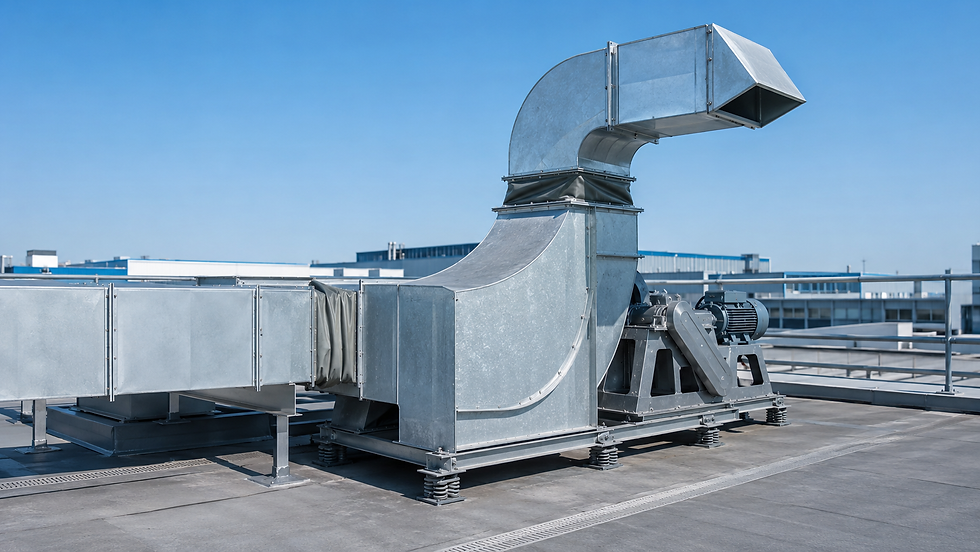
Centrifugal fans are generally more suitable for systems with long ducts, filters, collection hoods or multiple bends. Their pressure capability allows them to maintain airflow more effectively when system resistance increases. However, the impeller design, motor power, operating speed and fan curve must also match the required duty point.
Information Required for Accurate Fan Selection
Before selecting an industrial fan, collect the required airflow, estimated total pressure, duct length and diameter, elbow quantity, filter resistance, air temperature, medium, dust or moisture conditions, installation position, power supply, noise limits and operating time.
When exact pressure-loss calculations are unavailable, a duct layout or project drawing can help the POPULA engineering team estimate system resistance and narrow down suitable fan models.
Matching the Fan Curve to the System
A fan does not operate at one fixed airflow value. Its actual operating point is determined by the intersection between the fan performance curve and the system resistance curve. If resistance is underestimated, the operating point moves toward lower airflow.
Installing a larger motor alone may not solve the problem if the fan impeller and pressure characteristics are unsuitable. A reliable selection should match airflow and pressure simultaneously while avoiding excessive margins that increase noise, energy use and control difficulty.
Improving an Existing Ventilation System
Weak airflow does not always mean the fan must be replaced. Performance may improve by increasing duct diameter, reducing unnecessary elbows, using smoother transitions, cleaning filters, improving replacement-air supply, moving extraction points closer to the source and balancing dampers.
If these changes are insufficient, a higher-pressure POPULA centrifugal fan or another suitable industrial fan configuration can be selected according to the recalculated system conditions.
Industrial ventilation performance depends on the complete airflow path—not only the fan nameplate. By reviewing airflow, pressure, duct layout and operating conditions together, POPULA helps industrial customers choose fan systems that perform more reliably after installation.


Comments